
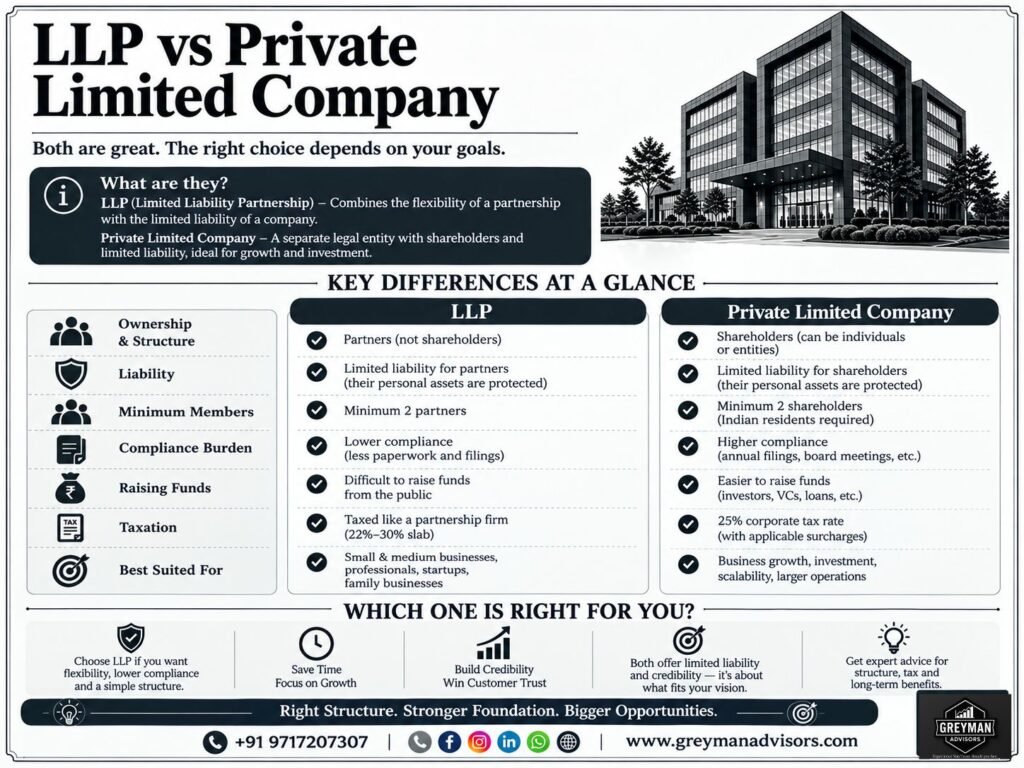
LLP vs Private Limited Company | Greyman Advisors
Quick Answer: When comparing LLP vs Private Limited Company, entrepreneurs in India must weigh two main options: Limited Liability Partnership (LLP) and Private Limited Company (Pvt Ltd). An LLP is preferred for professionals and small-to-medium businesses who wish to avoid complexities of compliance, whereas a Pvt Ltd Company is more suited for a startup that wishes to raise funds and appear credit-worthy.
Introduction: Importance of Business Structure
When starting a business in India, choosing the right business structure is one of the first and most crucial steps. A Limited Liability Partnership (LLP) and a Private Limited Company (Pvt Ltd) are two of the most common structures today. Both have their own pros and cons, but they share several similarities as well.
They provide limited liability protection to their owners and have a separate legal entity status. Furthermore, filing costs are comparable too.
However, they also have significant differences. A Pvt Ltd Company provides more credibility and is a preferred choice of investors, while an LLP has fewer compliance requirements. Additionally, a Pvt Ltd Company can raise funds easier and offers more flexibility in terms of ownership than an LLP.
According to the Ministry of Corporate Affairs (MCA), millions of businesses are registered in India every year, with LLPs and Pvt Ltd Companies comprising the lion’s share. Understanding the difference between these two entities better can help you save both time and money in the long run.
In this ultimate guide, we’ll discuss everything you need to know about the LLP vs Pvt Ltd Company debate and help you pick the right business structure for your needs.
What is an LLP (Limited Liability Partnership)?
A Limited Liability Partnership or an LLP is a hybrid business structure which has elements of both a company and a partnership. As per the Limited Liability Partnership Act, 2008, an LLP provides its partners with a limited liability shield similar to that of a company and a partnership gives flexibility.
Key Characteristics of an LLP
Governs by Limited Liability Partnership Act, 2008
1 or more partners (minimum 2 designated partners)
Limited liability protection to its partners
Separate legal entity.
Less Compliance as compared to Pvt Ltd Company
No mandatory audit unless turnover or contribution is beyond certain limits.
No share capital concept, partners contribute as per the LLP agreement
An LLP is a preferred business structure for professionals like lawyers, consultants, architects, and CA firms. It has the tag of a company but the feel of a partnership.
What is a Pvt Ltd (Private Limited Company)?
A Pvt Ltd Company (Private Limited Company), is a type of Company, governed by the Companies Act, 2013. It is a restricted liability business structure suitable for startups, technology driven product or services and businesses looking to raise capital or investors.
Key Characteristics of a Pvt Ltd Company
Governing Act: Companies Act, 2013
Minimum: 2 directors, 2 shareholders (can be same person)
Maximum: 200 shareholders
Separate legal entity with perpetual succession
Can issue share capital to raise capital from angel and VCs
Statutory audit mandatory even if turnover is low
More compliance than LLP
Eligible for Startup India benefits
A Pvt Ltd Company is a preferred choice among investors for various reasons including its flexible ownership structure and ability to raise funds through venture capital, angel investors, private equity and initial public offerings (IPO).
LLP vs Private Limited: Detailed Comparison
| Parameter | LLP | Pvt Ltd Company |
| Governing Law | Limited Liability Partnership Act, 2008 | Companies Act, 2013 |
| Minimum Members | 2 Designated Partners | 2 Directors and 2 Shareholders |
| Maximum Members | No limit | 200 |
| Legal Status | Separate legal entity | Separate legal entity |
| Liability | Limited to contribution | Limited to share capital |
| Minimum Capital | No minimum requirement | No minimum requirement |
| Audit Requirement | Only if turnover/contribution > ₹40 Lakh/₹25 Lakh respectively | Mandatory |
| Compliance | Low – lesser ROC filings | High – mandatory filings, board meetings etc. |
| Foreign Investment (FDI) | Generally not allowed | Allowed under automatic route |
| Equity Funding / VC | Not possible | Possible |
| Transfer of Ownership | As per LLP agreement | Easy |
| Tax Rate | 30% on profits | 22% on profits for domestic companies |
| Conversion | To Pvt Ltd possible | To LLP possible |
| Startup India Benefits | Limited eligibility | Eligible |
| Annual Filing Cost | Lower | Higher |
LLP vs Private Limited: Cost Analysis
LLP Registration Process
- Obtain DSC (Digital Signature Certificate) for designated partners.
- Apply for DPIN (Designated Partner Identification Number).
- Fill and submit FiLLiP (Form for Incorporation of LLP) online portal of MCA.
- Apply for name approval using RUN-LLP form.
- Submit LLP agreement to the registrar within 30 days of incorporation.
- Receive Certificate of Incorporation from the Registrar of Companies (RoC).
- Estimated time: 7 to 15 working days. Cost: Rs. 500 to Rs. 5,600 (depending upon capital contribution).
Pvt Ltd Company Registration Process
- Obtain DSC for all proposed directors.
- Apply for DIN (Director Identification Number) using SPICe+ form.
- Submit RUN form for name availability.
- File SPICe+ Part B, AGILE-PRO-S, and e-MOA/e-AOA documents.
- Apply for PAN, TAN, EPFO/ESIC, GSTIN, and bank account using SPICe+ AGILE.
- Receive Certificate of Incorporation with CIN (Corporate Identification Number) from the RoC.
- Estimated time: 7 to 15 working days. Cost: varies based upon authorised share capital.
Compliance Requirements LLP vs Pvt Ltd
Compliance is one of the most important factors to consider when deciding between an LLP and a Pvt Ltd Company. In fact, understanding compliance requirements can help you avoid penalties and unnecessary hassles.
LLP Annual Compliance
- Form 11 (Annual return) – due by 30th May every year
- Form 8 (Statement of Accounts and Solvency) – due by 30th October every year
- Income Tax Return filing
- Audit mandatory if turnover or contribution exceeds 40 Lakh/25 Lakh
- No mandatory board meetings or AGMs (Annual General Meetings)
Pvt Ltd Company Annual Compliance
- Minimum 4 board meetings in a year (The first one should be held within 30 days of incorporation)
- Annual General Meeting (AGM) is mandatory every year
- AOC-4 (financial statements) due within 30 days of AGM
- MGT-7 (annual return) due within 60 days of AGM
- Statutory Audit – mandatory every year irrespective of turnover
- DIR-3 KYC filing – mandatory for directors
- Income Tax Return and ROC filings
- Verdict: Overall, an LLP has lesser compliance requirements compared to a Pvt Ltd Company. Therefore, an LLP is more suitable for small businesses and professionals who do not wish to spend time and effort dealing with complex compliance procedures.
Taxation Rules for Each Structure
LLP Taxation
- LLPs are subject to a 30% tax on profits
- Surcharge of 12% if profit exceeds Rs. 1 crore
- Health and Education Cess of 4% on tax and surcharge
- No Dividend Distribution Tax (DDT) applicable
- Profit in the hands of partners is exempt from tax (avoidance of double taxation)
- LLPs are not entitled to benefits under Section 115BAA (lower corporate tax rate)
Pvt Ltd Company Taxation
- Eligible for a 22% tax rate (plus surcharge and cess – effective tax rate of ~25.2%)
- New manufacturing companies incorporated on or after 1st October 2019 have an option to pay tax @ 15% (under Section 115BAB)
- Dividend is taxed in the hands of shareholders
- Applicable Minimum Alternate Tax (MAT) of 15% on book profits
- Eligible for various deductions under Section 80 etc
- Verdict: As per the new tax regime in India, a Pvt Ltd Company can provide substantial tax benefits for businesses with high profitability. On the contrary, an LLP may be a better choice for small businesses where profit distribution is relatively straightforward.
Funding and Investment Differences For LLP Company and Pvt Ltd
If you want to raise capital or attract investors, then you must know the key differences between an LLP and Pvt Ltd Company. An LLP cannot issue any share. So there is another disadvantage of an LLP that FDI (Foreign Direct Investment) is not allowed apart from the sectors which are open for FDI.
A Pvt Ltd Company can raise funds from private equity, venture capitalists, angel investors, IPO (Initial Public Offering) and ESOPs (Employee Stock Option Plans) can also be issued to employees by a Pvt Ltd Company to motivate them.
Funding Alternatives for LLP and Pvt Ltd Company
- Equity Shares
- Preference Shares
- Compulsorily Convertible Debentures (CCDs)
- Compulsorily Convertible Preference Shares (CCPS)
- Verdict: Based upon your funding requirements, you can select the most suitable business structure. An LLP is not a viable option if you are considering raising money from venture capitalists or angel investors.
When to Choose an LLP (Limited Liability Partnership)?
An LLP is more appropriate for the following scenarios:
You are a professional services provider – CA, lawyer, architect, or a consultant.
You are not looking to raise any equity funding.
You prefer a lower degree of compliance and find processing paperwork tedious.
You only work with domestic partners and do not intend to allow any foreign direct investment (FDI).
You want more flexibility in terms of profit distribution to partners without having to deal with complex dividend rules.
You run a small business with turnover less than Rs. 40 Lakh
When to Choose a Pvt Ltd Company (Private Limited Company)?
A Pvt Ltd Company is more appropriate for the following scenarios:
You are a tech startup or product-oriented business.
You are looking to raise funds from angel investors, venture capitalists, or private equity.
You want to attract employees with ESOPs (Employee Stock Option Plans).
You are a domestic company considering accepting foreign direct investment (FDI).
You are looking to take advantage of Startup India benefits and tax holidays.
You want to eventually go public (through an IPO) or sell your company (M&A exit).
Converting Between the Two Structures
A Pvt Ltd Company can be converted to an LLP and vice versa, although the process may be time-consuming and involve additional expenses.
LLP to Pvt Ltd Company Conversion
A conversion from LLP to Pvt Ltd Company is possible under Section 366 of the Companies Act, 2013. In this process, the LLP’s existing partners will need to apply to the Registrar of Companies (RoC) with a NOC (No Objection Certificate) from all creditors. Conversion is typically done when an LLP wants to raise equity funding or list on a stock exchange in the future.
Pvt Ltd Company to LLP Conversion
Conversion from a Pvt Ltd Company to an LLP is permissible under the Limited Liability Partnership Act, 2008. This conversion is done primarily to reduce compliance and processing costs. However, this is not possible for companies with FDI (Foreign Direct Investment) or those that are listed on a stock exchange.
Cost of Setup and Maintenance For LLP and Pvt Ltd Company
Another important consideration is the cost associated with setting up and maintaining an LLP or a Pvt Ltd Company. Startups and small businesses often have a limited budget and cannot afford steep annual fees.
LLP Cost Analysis
- Registration cost: Rs. 2,000 to Rs. 10,000 (depends upon government fees and professional fees)
- Annual compliance cost: Rs. 5,000 to Rs. 15,000 (CA + ROC fees)
- Audit cost (if applicable): Rs. 5,000 to Rs. 25,000 (depends upon the size of the firm)
- No mandatory share capital requirement
Pvt Ltd Company Cost Analysis
Registration cost Rs. 7,000 to 20,000 Rs. 1,00,000 (varies with government and professional fees)
Annual compliance cost Rs. 15,000 to 40,000 (audit + CA + ROC + legal fees) Higher than LLP due to higher compliance needs.
Statutory audit cost Rs. 10,000 to 50,000+ Costlier than LLP
Board meeting and AGM expenses (For venue hire, documentation etc.) Not applicable Some costs would be incurred.
Verdict: An LLP generally has lower set up and maintenance cost as compared to a Pvt Ltd Company. Hence it is more feasible for small entities and professionals. Secondly a Pvt Ltd Company has higher compliance needs which makes it costlier.
Brand Image and Market Credibility
Both an LLP and a Pvt Ltd Company have a high degree of credibility as separate legal entities. However, a Pvt Ltd Company tends to enjoy greater credibility with banks, large corporations, and international clients.
The term ‘Private Limited’ at the end of a business name lends it more credibility, especially in B2B (Business-to-Business) dealings. Opening a current account, obtaining credit facilities, and securing large contracts may be easier with a Pvt Ltd Company.
On the contrary, an LLP is more credible among professional services such as consultants, accountants, and lawyers. In B2C (Business-to-Consumer) dealings, however, the term LLP (Limited Liability Partnership) may not always resonate well with some clients or investors.
Startup India Registration: Eligibility Criteria Difference
The Startup India initiative by the Indian government has many benefits including tax holidays and eased compliance procedures. To be eligible for the benefits one must satisfy certain requirements, including:
It should be incorporated or registered in India
It should not have been set up more than 10 years ago on the day of incorporation
Its turnover should not exceed Rs. 100 crore in any financial year
It should be working towards innovation, development, and enhancement of products/services
Both an LLP and a Pvt Ltd Company are eligible for Startup India benefits. However, some benefits such as 3 years of tax holiday as per section 80-IAC are only available to eligible startups incorporated as a Pvt Ltd Company or an LLP.
Angel tax exemption under section 56(2)(viib) of the Income Tax Act is also available to eligible startups that are incorporated as either an LLP or a Pvt Ltd Company. Furthermore, DPIIT-registered Pvt Ltd Companies enjoy additional benefits under various government schemes such as the Fund of Funds for Startups (FFS).
Conclusion: Choosing the Best Business Structure
There is no definitive answer to the age-old question of LLP vs Pvt Ltd Company. It mostly depends upon your individual requirements, including compliance preferences, funding aspirations, and brand image requirements.
An LLP is a suitable choice for professionals and small businesses, whereas a Pvt Ltd Company is a better option for startups, investors, and scalable ventures. However, both entities offer limited liability protection and credibility as separate legal entities.
Ultimately, it is best to consult a qualified Chartered Accountant (CA) and Company Secretary (CS) to make the most appropriate decision.
Need Help with GST Registration?
Let our expertsat Greyman Advisors handle it — accurately, quickly, and without the paperwork headache.
Frequently Asked Questions (FAQs)
Q1. Can an LLP be converted to a Pvt Ltd Company?
An LLP can be converted to a Pvt Ltd Company under Section 366 of the Companies Act, 2013 by filing of Form URC-1 with the Registrar of Companies (RoC) along with other documents.
Q2. Is LLP better than Pvt Ltd Company?
It depends upon the requirements of an entity. An LLP has lesser compliance and processing costs while a Pvt Ltd Company offers more credibility with clients and investors. Moreover, a Pvt Ltd Company can raise funds easily while an LLP is not eligible for many tax benefits.
Q3. Can a single person register an LLP or Pvt Ltd Company?
No, a single person cannot register either an LLP or a Pvt Ltd Company. An LLP requires a minimum of 2 designated partners while a Pvt Ltd Company requires at least 2 directors and 2 shareholders. However, a single person can incorporate a One Person Company (OPC) as per the Companies Act, 2013.
Q4. Which company structure is preferred by investors?
Investors greatly prefer a Pvt Ltd Company as it allows them to become shareholders. In addition, a Pvt Ltd Company can also raise funds via ESOPs (Employee Stock Option Plans) and issue convertible securities such as CCDs (Compulsorily Convertible Debentures) and CCPS (Compulsorily Convertible Preference Shares).
An LLP is generally not investable by venture capitalists (VCs), private equity (PE) firms, or angel investors.
Q5. Is there any minimum capital requirement for an LLP or Pvt Ltd Company?
As per latest guidelines, there is no minimum capital requirement for an LLP or a Pvt Ltd Company in India. You can incorporate either entity with a small amount of capital.